




Bringing the Breast to the Bottle: How to Breastfeed and Bottle Feed Without Losing Your Nursing Relationship
Maybe you’ve been breastfeeding for weeks and it’s finally clicking. The latch is better, your supply is establishing, and you’re starting to find your rhythm. And now you need to introduce bottle feeding because you’re going back to work, or your partner wants to share a feed, and you’re terrified of undoing what you’ve worked so hard to build.
Or maybe you’re only days postpartum and you haven’t even fully found that rhythm yet. You’re still in the thick of learning your baby, still figuring out the latch, still hoping this is going to work, and your pediatrician just told you your baby needs to be supplemented. For weight gain, for jaundice, or for a medical reason you didn’t see coming and didn’t plan for. You said yes because of course you said yes, your baby needs it. And then you walked out of that office with a bottle in your bag and a knot in your stomach, wondering if this is the beginning of the end of breastfeeding.
You’re not in the same place. But you’re holding the same fear every mom who needs to breastfeed and bottle feed holds: what if the bottle breaks what we’re trying to build?
Here’s what I want you to know before we go any further: how you offer a bottle matters enormously. The technique isn’t an afterthought. Done well, bottle feeding can actually honor your breastfeeding relationship rather than compete with it. Whether you’re two weeks in or two months in, these techniques protect what you have and support where you’re trying to go. And I put together a free guide with my four core techniques to help you do exactly that.
But first, there are two separate fears underneath the question “will this bottle ruin breastfeeding?” and they need two separate answers. The first is about your baby’s latch and preference. The second is about your supply. Let’s address both.

If You’re Supplementing Early: Please Don’t Skip This Section
For moms who are days or weeks postpartum and supplementing on medical advice, the bottle technique matters and so does something else that often gets lost in the chaos of those early days: your breast still needs to be stimulated, even when your baby is taking a bottle.
Milk supply is built and maintained through frequent stimulation and emptying of the breast. Research consistently supports that babies with long term breastfeeding success latch to the breast ten to twelve times per day in the early weeks. That frequency isn’t arbitrary, it’s the signal your body needs to understand how much milk to keep making. When bottles replace breast sessions without your breast being stimulated in their place, your body receives less demand and responds accordingly: supply drops.
This is the part that catches so many moms off guard. They supplement because they have to, the bottle goes well, the baby seems fine and then a few weeks later they notice their supply has quietly declined, and they aren’t sure why.
Here’s what protects against that
Every time your baby takes a bottle instead of nursing, consider pumping or hand expressing to replace that breast stimulation. This doesn’t have to be a long session. Even ten minutes of pumping maintains the signal that matters. And whenever possible, offer the breast first before supplementing. Your baby’s latch, even if it isn’t transferring full feeds yet, still counts as stimulation.
A lactation consultant is your most valuable resource for navigating this. If you’re supplementing for weight gain, jaundice, or any early medical reason, a certified lactation consultant (IBCLC) can help you build a supplementation plan that supports your baby’s needs without quietly undermining your supply goals. They can assess transfer, guide your pumping schedule, and help you understand when and how supplementation can be reduced as breastfeeding strengthens. If you don’t already have one, ask your pediatrician, OB, or midwife for a referral, or reach out to a local breastfeeding support group. This is exactly what they’re there for.
The bottle techniques in this post protect your baby’s latch. A lactation consultant helps protect your supply. Together, they give you the best possible chance of getting to the breastfeeding relationship you’re working toward.
Why Babies Struggle When You Breastfeed and Bottle Feed (It’s Not What You Think)
When a breastfed baby resists a bottle or seems to fall apart at the bottle when they nurse beautifully, parents usually assume something is wrong with the baby. They are too picky. Too attached. Too stubborn.
That’s not what’s happening.
Breastfeeding and bottle feeding are genuinely different motor tasks. At the breast, your baby controls the flow. They work to get milk, and that effort regulates the pace of the feed. When milk flows too fast from a bottle nipple, your baby can’t keep up. They gulp, they drool, they swallow air, they pull off and cry, they fall asleep exhausted after taking in more than they were ready for. And then, understandably, they start to resist.
The problem isn’t the bottle. It’s the flow, and the way the bottle is being offered.
As a pediatric speech language pathologist specializing in infant feeding, this is exactly the kind of pattern I assess and address in my clinical work. Feeding isn’t just about getting milk in. It’s a coordinated sensory and motor experience that either builds your baby’s confidence as a feeder or erodes it. When the technique matches your baby’s developmental readiness, everything changes: calmer feeds, better intake, less gas, and a baby who moves between breast and bottle without confusion.
The Four Things That Make Bottles for Newborns Breastfeeding Actually Work
These aren’t tricks or hacks. They’re techniques grounded in how infant feeding actually works.
1. Position your baby to reduce gravity
Most people hold a bottle fed baby in a semi-reclined cradle position. It’s intuitive, it’s comfortable, and it’s also exactly what makes bottle feeding hardest for breastfed babies. When a baby is reclined, gravity does the work. Milk flows toward the throat whether your baby is actively sucking or not. That passive transfer is the root of gulping, gas, and overwhelm.
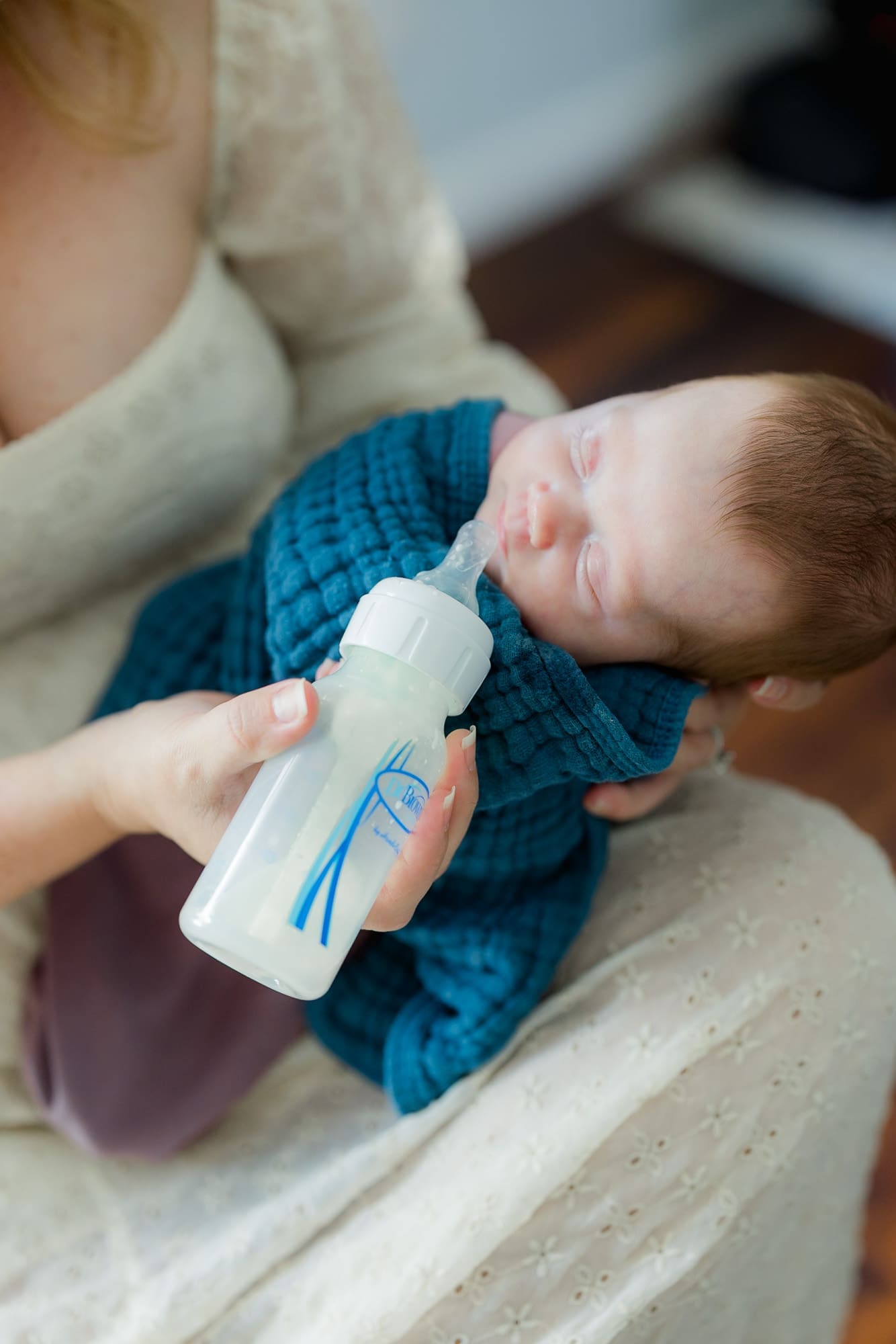
The goal is a position that puts your baby in control. Two options work well: upright (baby held against your chest or shoulder, more vertical than horizontal) or side-lying (bottom tucked against your belly, supported head toward your knee). Both achieve the same thing by giving your baby the time to coordinate each swallow at their own pace. Your baby has to actively suck to express milk, the same way they do at the breast.
Either position works. What matters is that gravity is no longer running the feed, your baby is.
2. Start at the nose, then wait
This one feels counterintuitive, but it works because it mirrors what happens at the breast. Rest the nipple tip at the base of your baby’s nose and stroke gently downward. This triggers the rooting reflex, which is the same reflex that brings your baby to the breast. Then wait. Don’t push the nipple in. Wait for a wide, open gape before you bring the nipple to their mouth.
The gape is the invitation. It’s always worth the pause.
3. Offer the nipple empty first
At the breast, your baby works before milk flows. That effort, a few seconds of non-nutritive sucking before letdown, is actually important. It helps your baby settle into a rhythm, signals their body that a feed is beginning, and builds the oral motor skill that makes them a competent, efficient feeder over time.
You can replicate this at the bottle. Offer the nipple empty first, let your baby begin to suckle, then tilt the bottle to allow flow. A small pause with a big difference in how the whole feed unfolds.
4. Let your baby lead and watch for fullness cues
Feeding is a conversation, not a task to finish. Throughout the feed, watch your baby: a slowing suck, relaxing hands, turning away. These are fullness cues, and they deserve to be honored. A baby who stops at 60% of the bottle did it well if they were comfortable and calm the whole way through.
Resist the urge to encourage more. Spinning the nipple or pumping it in and out of your baby’s mouth to stimulate them to keep going isn’t encouraging, it’s overriding. Soft talking or a gentle stroke of the cheek will always serve them better.
Volume follows quality. When babies trust the feed, intake takes care of itself.

A Note on Slow Flow Nipples (Because the Marketing Is Confusing)
Slow flow does not mean a slow feed and this distinction matters more than the nipple packaging will ever tell you.
Babies using slow flow nipples are often more efficient and take more volume than babies using faster flow nipples, because they control the pace and stay engaged. When milk comes too fast, babies can’t keep up. They gulp, drool, or disengage because they’re overwhelmed.
A slow flow nipple puts your baby in charge the same way they’re in charge at the breast. For most breastfed babies, I recommend starting with the slowest flow available, even if it feels unnecessarily slow. The research supports it, and your baby’s cues will confirm it. If you’re dealing with specific problems such as your baby falling asleep after a few sucks, gulping, choking, or arching away. I go deeper on what’s actually happening and how to fix it in Bottle Feeding Problems: A Pediatric SLP’s Guide for Tampa Parents.
When to Keep Going and When to Stop
One of the most common questions I hear from parents: How do I know if the feed is going well?
A feed is going well when your baby looks calm and engaged, their hands are soft and relaxed (not fisted or splayed open in stress), they’re pausing naturally between bursts of sucking, and they’re not gulping or drooling excessively.
A feed needs to stop or pause when your baby turns away, arches back, gets stiff, or becomes drowsy to the point of disengagement. If they get too sleepy, stop and offer a burp break. Only continue if they show renewed interest. Pushing through when your baby is telling you they’re done is exactly the pattern that leads to bottle aversion and feeding anxiety down the line.
Trust what you see. Your baby is communicating constantly. The more fluent you become in reading those cues, the more confident you’ll feel at every feed whether bottle or breast.
Your Free Guide: Four Techniques to Try Today
Everything covered in this post lives in a single printable reference you can keep in your feeding bag, share with your partner, or send to your daycare provider. It’s called Bringing the Breast to the Bottle, and it walks through each technique with clear, specific guidance you can use starting at your next feed.
No fluff. No “every baby is different” non-answers. Just the four techniques that actually work. Explained the way I’d explain them to a parent sitting across from me in a feeding consultation.
Print it, save it to your phone, share it with anyone who feeds your baby. It’s yours.
One More Thing
Understanding the way your baby communicates comfort, hunger, fullness, and overwhelm is something I bring to every aspect of my work. As a newborn photographer with NICU training and pediatric SLP expertise, reading infant communication is the same skill that keeps my studio sessions calm, baby led, and truly safe for the newest members of your family.
If you’re expecting and thinking about newborn photos, you can learn more about how I work HERE.
Frequently Asked Questions
When is the right time to introduce a bottle to a breastfed baby?
Most lactation consultants and feeding specialists recommend waiting until breastfeeding is well established, typically three to four weeks, before introducing a bottle. If you’re returning to work, plan to practice two to three weeks before your first day back. Earlier introduction (in the first week) can interfere with milk supply and nipple preference before feeding patterns are stable.
My baby refuses every bottle we’ve tried. What do we do?
Bottle refusal in breastfed babies is extremely common and almost always resolvable with the right technique and timing. Start with the techniques in this post: upright or side-lying positioning to reduce passive flow, slow flow nipple, nose trigger before offering. Also, try having someone other than the nursing parent offer the bottle. Many babies will accept more readily when mom isn’t in the room. If refusal persists after consistent attempts over one to two weeks, a feeding consultation can help identify whether there’s an underlying sensory or oral motor component.
Does bottle feeding cause nipple confusion?
True nipple confusion where a baby forgets how to nurse after bottle feeding is less common than nipple preference, where a baby begins to prefer the bottle because it’s easier or faster. Paced feeding techniques like the ones in this post significantly reduce the risk of bottle preference by keeping the bottle experience as close to breastfeeding as possible in terms of pacing and effort.
How many ounces should a breastfed baby take from a bottle?
Breastfed babies typically take between one and one-and-a-half ounces per hour of separation. So a four hour stretch would require four to six ounces total. This is generally lower than formula fed bottle volumes because breastmilk is more efficiently digested. Pace the feed, watch for fullness cues, and resist pressure to finish a specific volume at each sitting.
Can I use these techniques even if I’m exclusively pumping?
Absolutely. These techniques apply to any bottle feed, regardless of what’s in the bottle. Upright or side-lying positioning, slow flow nipple, paced offering, and following fullness cues support healthy feeding patterns for all bottle fed babies and are especially beneficial for babies who have had NICU stays or early feeding challenges.

Tina Marie Studio is a Tampa Bay boutique photography studio where sessions are unhurried, the expertise runs deep, and the photos end up on your walls.
Owner and photographer Tina is a Certified Neonatal Therapist with NICU experience and a Pediatric SLP specializing in infant feeding. These credentials shape every session she photographs, especially with newborns and young families. She photographs families across Tampa, St. Petersburg, Clearwater, Wesley Chapel, and the surrounding area.





Comments +