

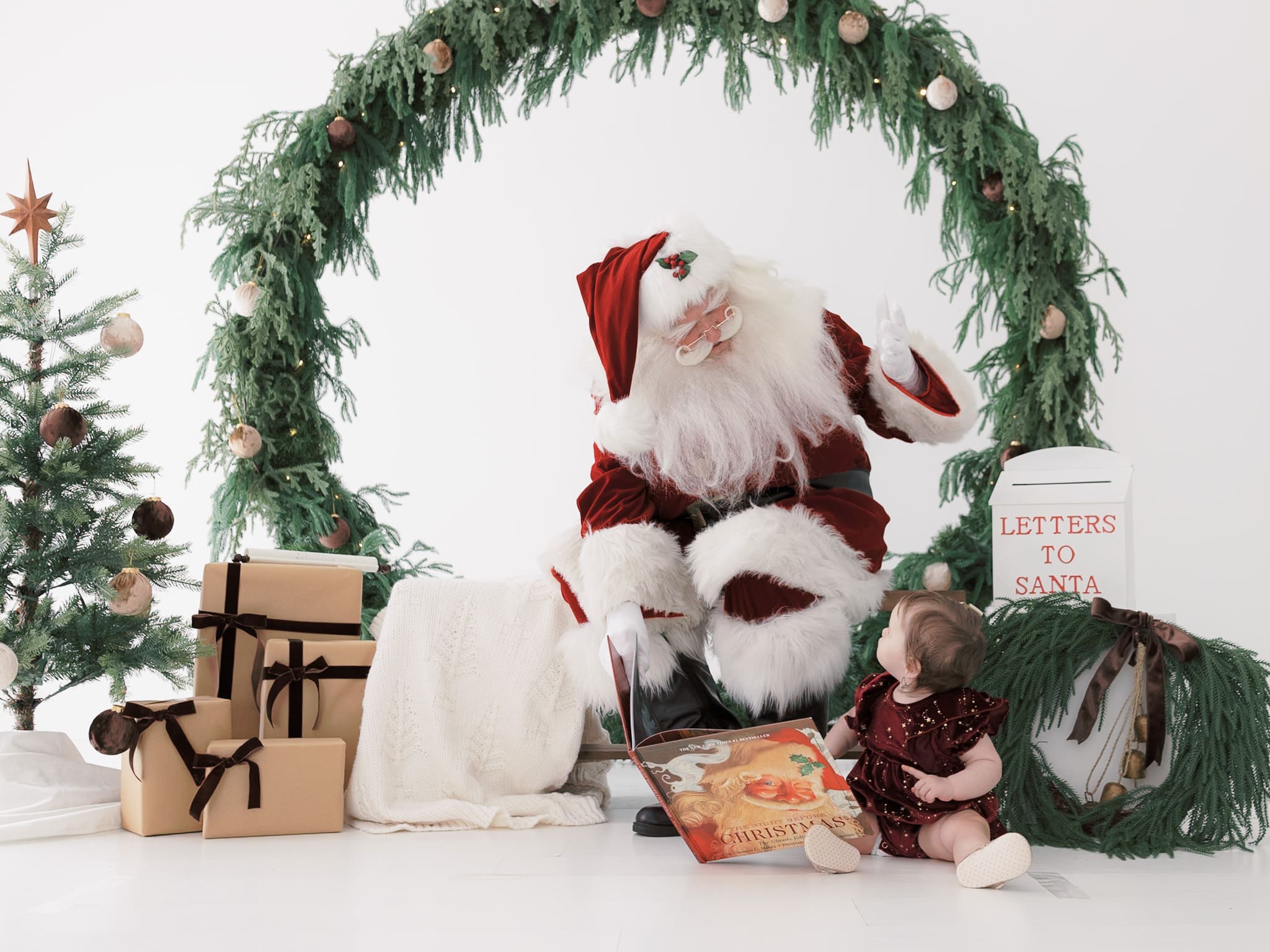


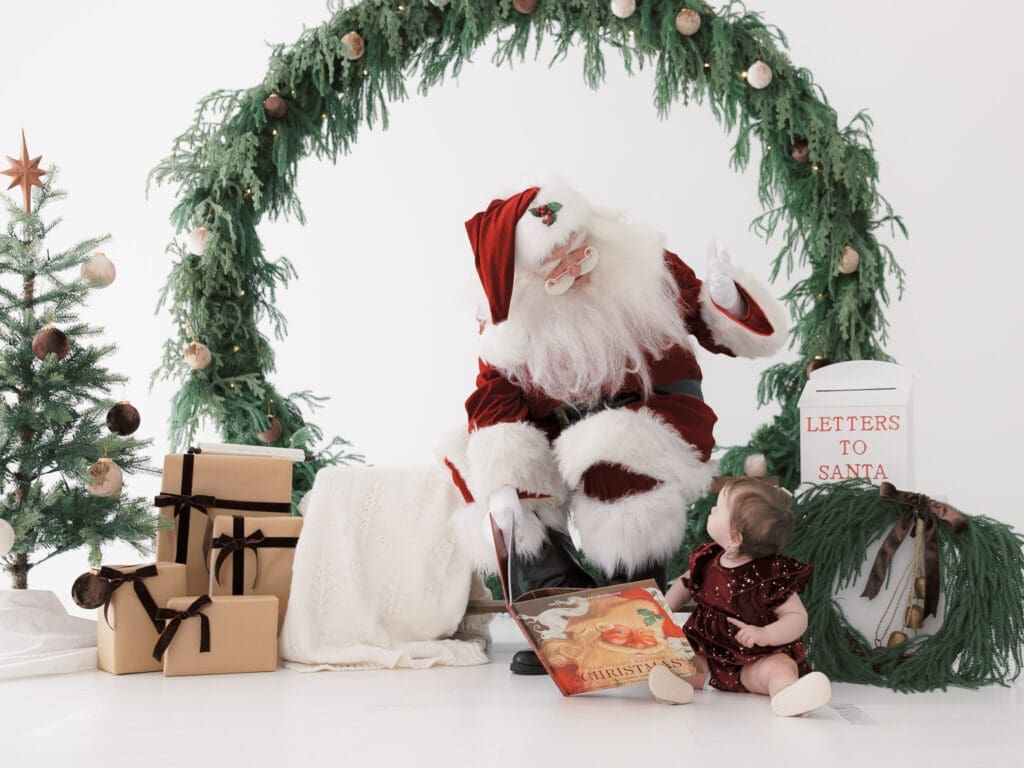
During last year’s pictures with Santa, I photographed a baby girl experiencing her very first Santa. Her very first Christmas.
She cried the moment she saw him.
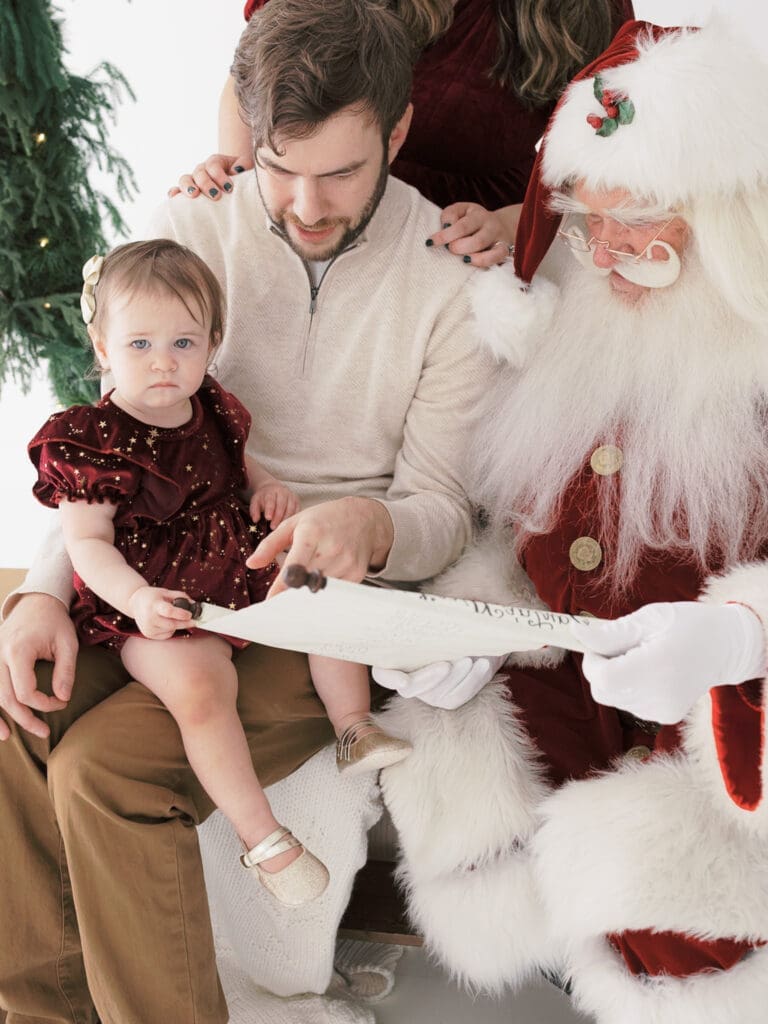
We didn’t push through it. We didn’t force her to sit on his lap and hope for the best. We set her down on the ground in front of Santa, gave her some space, and he leaned down and started reading her a book. She stopped crying. She was completely fascinated. Her parents sat beside Santa, held her close, and we got the sweetest moments of the whole day.
None of that was the plan. All of it was better than the plan.
That session is a good reminder of what pictures with Santa can actually be when you stop trying to force the standard pose and start following the child in front of you. Some kids walk straight up to Santa and climb on his lap. Some need five minutes on the floor with a book first. Both are completely okay and both produce images families keep forever.
As a Pediatric Speech Language Pathologist who has spent years working with children at every developmental stage, I understand how kids process new experiences, unfamiliar people, and big environments. That knowledge shapes every Santa session I design and it’s behind everything I’m about to share.
Whether your child is a baby experiencing Santa for the first time, a toddler in full stranger anxiety mode, or a five-year-old who has been talking about the North Pole since August, here’s what actually works.
Why Do So Many Kids Cry During Pictures with Santa?
Let’s start with the honest answer: Santa is objectively a lot.
A large person in a dramatic red costume, sitting in a decorated space, surrounded by strangers, expecting a small child to approach, sit down, and smile on command. When you frame it that way, the question isn’t why kids cry. It’s why more of them don’t.
From a child development standpoint, what you’re witnessing is a completely appropriate fear response. Stranger anxiety peaks between 8 and 18 months and remains strong through toddlerhood. The visual complexity of Santa’s costume with the hat, the beard, the glasses, and the suit creates what developmental specialists call a “novel visual stimulus.” A child who loves Santa in books is recognizing a flat, familiar image. The real thing activates an entirely different response in their nervous system.
Toddlers can’t be talked through the logic of why this is fun. They feel what they feel and their nervous system responds accordingly, even if five minutes earlier they were excitedly telling you about reindeer.
Here’s what I want every parent to know: some of the most beautiful pictures with Santa are not smiling photos. The wide-eyed stare. The trembling lip. The full, tears streaming meltdown. These images are the ones parents almost apologize for in the moment, but are the ones I watch families frame and keep for decades.
A difficult Santa session and a memorable one are often the exact same session. Your job isn’t to manufacture a smile. It’s to show up prepared so that whatever real moment happens can actually be captured.
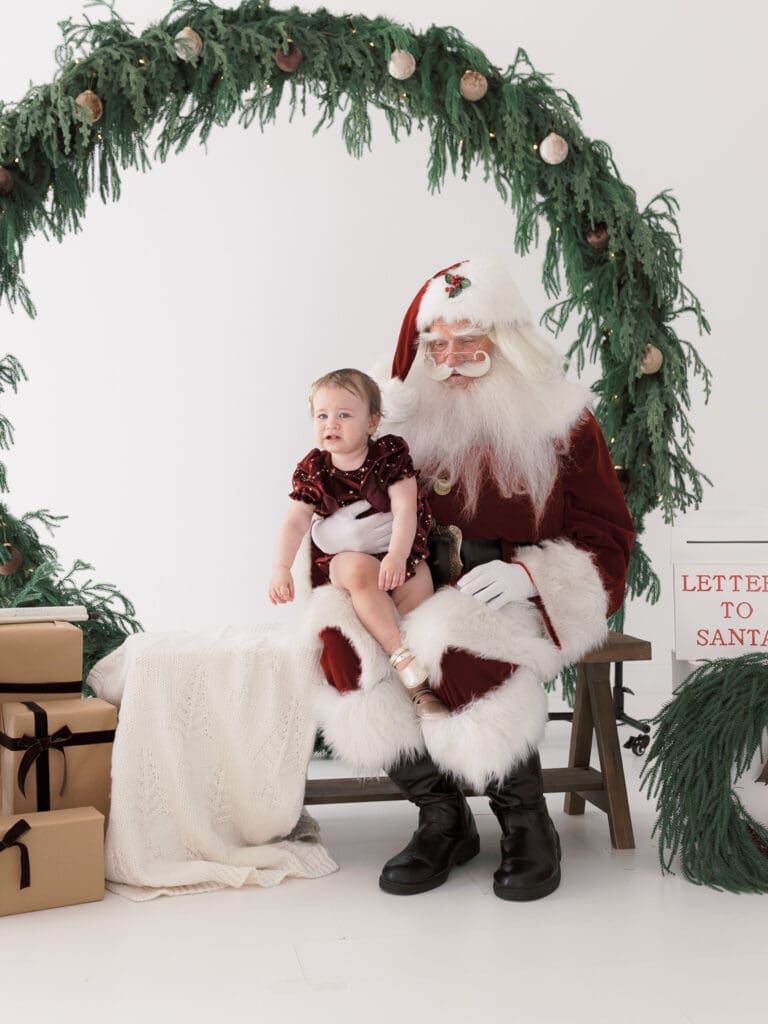
What to Expect at Every Age During Pictures with Santa
Understanding what’s developmentally typical at your child’s age is the single most powerful thing you can bring to a Santa session. Here’s what I see, year after year:
Babies under 12 months
Often the most cooperative and not because they love Santa, but because full stranger anxiety hasn’t fully developed yet. Most babies under 6 months will sit calmly in Santa’s arms with minimal protest. But the window is short. A hungry, tired, or overstimulated baby will let you know immediately, and timing everything around their schedule is non-negotiable at this age. And if they do cry? A book on the floor and a patient Santa can change everything.
Toddlers 12–36 months
Peak Santa fear territory. Stranger anxiety is fully developed, language isn’t yet sophisticated enough to process reassurance, and the expectation to perform is simply beyond what their nervous system can meet. My background as a Pediatric SLP has taught me that toddlers at this stage don’t respond to logic they respond to safety cues. Who’s holding them. What’s familiar in the room. Whether the adults around them seem relaxed.
Preschoolers 3–5
Wildly variable. A child who has been talking about Santa since October and has never met a stranger in their life will walk straight up and start chatting. A more cautious child who processes novelty slowly may need five or ten minutes of distance before they’re willing to engage. Both are completely normal and both produce beautiful images when a photographer follows the child’s lead rather than the clock.
School-age 5 and up
Generally more cooperative but the pressure to perform can create its own awkwardness. Older children who feel self-conscious often need permission to just be themselves rather than produce a perfect moment.
How Early Should You Talk to Kids About Pictures with Santa?
Earlier than you think. Weeks, not days.
Casual, low-pressure Santa exposure in the weeks before a session meaningfully shifts how a child walks through the door. Not because you’ve convinced them Santa is safe but because you’ve made him familiar. And familiar is what the nervous system responds to.
What actually works:
- Read Santa books together not as a buildup to the session, just as part of your normal routine. Let your child encounter Santa repeatedly in a cozy, low stakes context.
- Point out seasonal displays with zero pressure. “Look, there’s Santa!” and keep walking. No expectation to wave, approach, or engage.
- Describe the session simply and factually. “We’re going to visit Santa. You’ll sit near him. You can talk to him and give him your wish list. Miss Tina will take some pictures.” Keep it calm, not exciting.
- Role-play the meeting at home, for toddlers especially. Children who do better with rehearsed situations benefit enormously from a practice run. Have a family member sit in a chair and let your child approach on their own terms.
What not to do:
- Use the session as a behavior reward or threat (“If you’re good, you get to see Santa”)
- Promise your child they’ll love it
- Build up the event so much that the reality can’t match the expectation
Every family who books a session with me receives a preparation guide before they arrive. The difference it makes is real. Families who read it walk in calmer, more realistic, and more able to follow their child’s lead rather than their idea of a perfect photo.
What Is the Best Time of Day for Pictures with Santa?
If I could tell every family one thing that would most improve their experience, it’s this: your child’s nap and meal schedule matters more than their outfit, the backdrop, and everything else combined.
Book around your child’s best window. For most young children, this is mid-morning. Late afternoon is almost always harder. Tired children in stimulating new environments are working against everyone in the room.
What Should My Child Wear for Pictures with Santa?
The most important thing your child wears to a Santa session has nothing to do with color coordination.
Comfort.
The most common outfit mistake I see: a child in something brand new, stiff, itchy, or tight they’ve never worn before. The session becomes about the waistband that digs, the shoe that pinches, or the collar that scratches and not about Santa.
What I tell every family:
- Wear the outfit at home first. At least once, for at least an hour. Let your child move in it, sit in it, forget they’re wearing it. If they hate it at home, they’ll hate it in the studio.
- Prioritize familiar fabrics. Soft, worn-in, comfortable. Holiday doesn’t have to mean stiff.
- Check the shoes. New shoes are a session killer for toddlers. If the outfit requires new shoes, break them in before you come in.
- For siblings: coordinate without sacrificing any one child’s comfort. A perfectly matched set of miserable children produces very different photos than coordinated-but-comfortable kids who feel like themselves.
Every booking confirmation from Tina Marie Studio includes a styling guide so families aren’t making these decisions alone.
For more help on dressing your kids for Santa pictures, read my post: Christmas Family Photo Outfits that Photograph Beautifully
What Should We Bring to Pictures with Santa?
The day of bag is one of the most underrated parts of session prep. Here’s what actually helps:
Snacks. Familiar favorites, not messy. Bring them for the waiting area- not for the session itself, but for the transition into a new environment while your child is still calibrating. A child who’s had a snack is a meaningfully different child than one who hasn’t.
A comfort object. The stuffed animal or blanket that normally stays home is absolutely welcome. For toddlers especially, a familiar object in an unfamiliar space is a powerful regulator.
A backup outfit. Spills happen. Meltdowns happen. Having a second option removes all the stakes from the first one.
Your own calm. This is the most important thing you can bring, and it’s not in your bag. Children read parental anxiety immediately. If you’re tense about the outcome, they feel it. Your child’s nervous system is calibrating to yours from the moment you walk in the door.
If there’s someone in your group whose visible stress about getting a perfect photo will show up in the room, it’s worth an honest conversation before you arrive.
What If My Child Is Afraid of Santa?
First: this is completely normal, and it doesn’t mean your session is over.
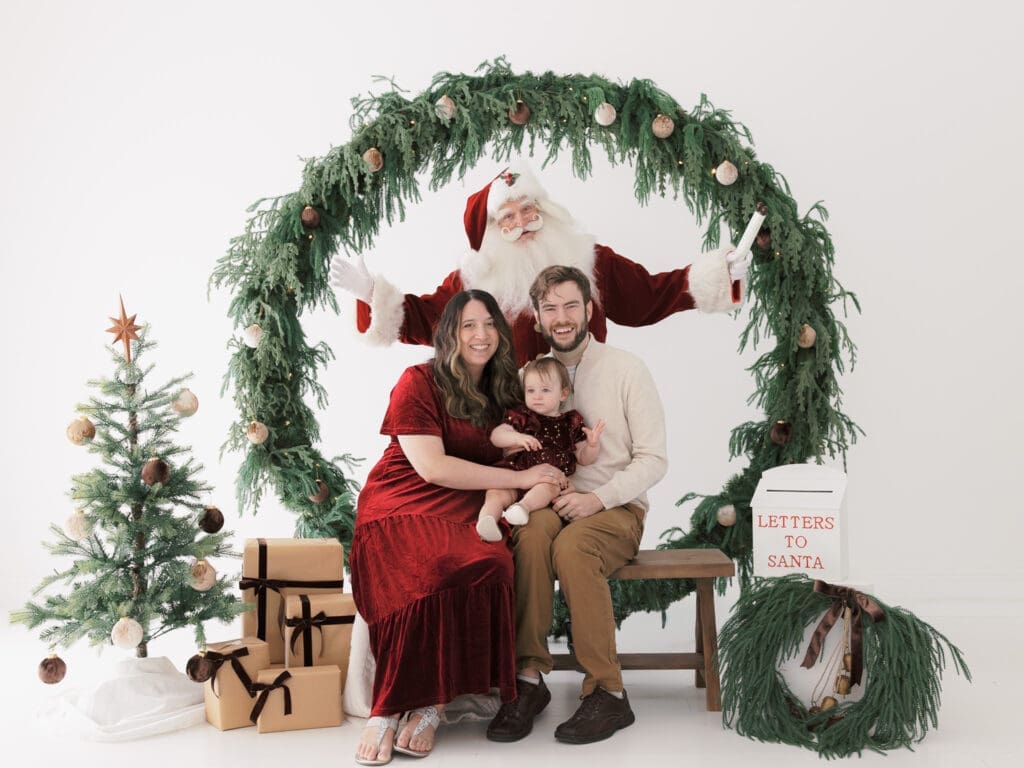
Last year, I had two shy little girls who weren’t sure about Santa at all. And a baby girl, her very first Christmas, who cried the moment she saw him. Here’s what we did: we set her down on the floor in front of Santa, gave her room, and he picked up a book and started reading to her. She stopped crying. She was transfixed. A few minutes later, her parents sat beside Santa, held her close, and we captured the sweetest moments of the whole session. None of it looked like a traditional Santa photo. All of it was better.
That’s what a child led session actually means in practice.
Santa fear exists on a spectrum. Some children are mildly uncertain. Some are genuinely, deeply terrified. Both are workable but they require a photographer who knows how to read a child and respond to what’s actually happening in the room, not what was planned.
What not to do when your child shows fear:
- Force the lap sit
- Bribe in ways that feel pressured (“You’ll get a treat if you sit with Santa”)
- Express visible disappointment in the moment
What actually helps:
Distance is your friend. Some of the most beautiful pictures with Santa don’t involve physical contact at all. A child sitting on the floor in front of Santa while he reads a book. A child standing five feet away, wide-eyed, taking in every detail. A parent holding their child while Santa leans in gently. These are often the shots families frame.
My Petite session exists specifically for children who aren’t sure about Santa yet. It’s five minutes, child-led, and designed to meet your child exactly where they are. No forced poses. No countdown to smile. If your child needs you in the frame, come camera ready, because those are often the most genuine images of the day.
What a Santa Session Looks Like When You Work with Me
At Tina Marie Studio in Carrollwood, Tampa, Santa sessions are intentionally small and private. No line. No waiting in a crowded space. No two-minute rush to get the shot before the next family comes in.
You arrive at a quiet studio. Your child has time to take in the environment before anything is expected of them. When they’re ready, Santa is there.
I set the pace based on your child. As a Pediatric SLP with years of experience working with children at every developmental stage, I know how to read what a child needs in the moment. I know when to give space, when to invite engagement, and when to bring a parent into the frame.
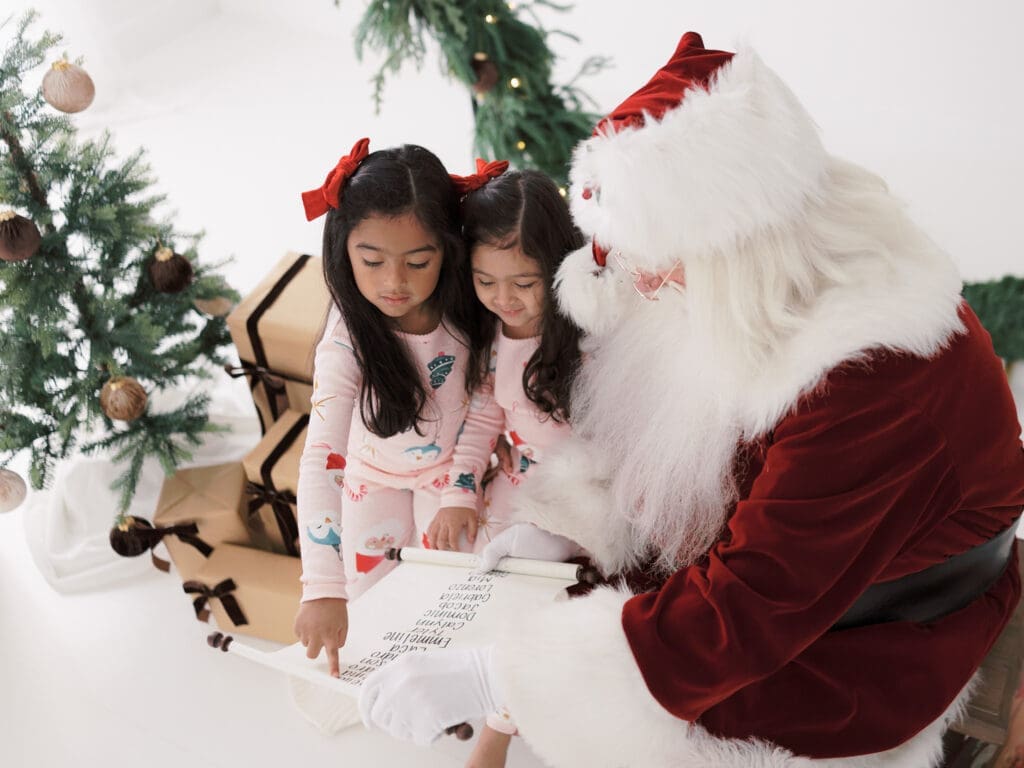
If the standard pose isn’t working, we don’t force it. We find the image that’s actually there. Sometimes that’s a baby on the floor with a book. Sometimes that’s a shy girl who warmed up just enough to stand beside Santa and give him a sideways glance. Both are worth framing.
After your session, your gallery is delivered within one week, followed by a gallery reveal and ordering appointment. Museum quality prints, special albums, and premium digital images are all available.
Get Your Kids Ready for Pictures with Santa
The families who have the best pictures with Santa aren’t the ones who somehow convinced their toddler to love strangers in red suits.
They’re the ones who showed up with realistic expectations, a fed and rested child, and a photographer who knew what to do when the plan fell apart.
Preparation isn’t about engineering a perfect moment. It’s about removing the obstacles so that whatever real moment happens can actually be captured. Sometimes that’s a grin. Sometimes it’s wide-eyed disbelief. Sometimes it’s a baby on the floor, completely captivated by Santa reading her a book, while her parents sit close and hold their breath.
All of it is worth framing.
Ready to book your Tampa Santa photos?
Frequently Asked Questions
How do I get my toddler to sit on Santa’s lap?
Honestly? Some toddlers simply won’t and that’s completely fine. Sitting on Santa’s lap is one option, not the goal. Alternative poses like sitting beside Santa, standing nearby, sitting on the floor while Santa reads a book, or staying in a parent’s arms while Santa leans in often produce more genuine images than any forced lap sit.
What age is best for pictures with Santa?
There’s no perfect age. Babies under 6 months are often cooperative but have a short window. Toddlers 12–36 months are in peak stranger anxiety territory. Preschoolers are wildly variable. School-age kids are generally easier but bring their own dynamics. Every age has its version of magic and its version of chaos. But who am I tellin’?
How do I prepare a shy child for pictures with Santa?
Start weeks before the session with casual, low pressure Santa exposure: books, seasonal displays, pointing him out with no expectation to interact. Role play a “meeting Santa” moment at home. Arrive well rested and well fed, and let your child set the pace entirely.
Should I force my kid to take pictures with Santa?
No. A forced, frightening interaction can make the following year harder. A low pressure session that meets your child where they are, even if it doesn’t produce the photo you imagined, creates a far better foundation for the years ahead. The images that come from a child led approach are almost always more genuine anyway.
What should kids wear for pictures with Santa?
Comfort first. Choose familiar fabrics, worn in shoes, and nothing new, stiff, or scratchy. Wear the outfit at home at least once before the session. For siblings, coordinate without sacrificing any one child’s comfort. A beautifully matched but miserable child is still a miserable child.
Can parents be in pictures with Santa for young children?
Absolutely. For babies, toddlers, and any child who needs a trusted adult nearby, a parent in the frame isn’t a compromise. It’s often what makes the photo work. If you’re booking a Petite session, come camera ready.

Tina Marie Studio is a Tampa Bay boutique photography studio where sessions are unhurried, the expertise runs deep, and the photos end up on your walls.
Owner and photographer Tina is a Certified Neonatal Therapist with NICU experience and a Pediatric SLP specializing in infant feeding. These credentials shape every session she photographs, especially with newborns and young families. She photographs families across Tampa, St. Petersburg, Clearwater, Wesley Chapel, and the surrounding area.


Comments +